Dealer Wall Clocks: The Boutique Pieces Watch Brands Won't Sell
Walk into an Audemars Piguet, Hublot, or Officine Panerai boutique and look up. More often than not, an oversized version of the house's signature watch hangs on the wall, sweeping the minutes in a scale no wrist could carry. Ask the sales associate if it's for sale, and the answer is almost always no. These boutique wall clocks were built to stay exactly where they are — which is precisely why the small number that have escaped into private hands now form one of the more curious corners of watch-brand collecting.
Unlike a wristwatch, a wall clock built by Rolex, Patek Philippe, or Audemars Piguet was never meant to be sold. It was meant to sell. That distinction — between an object created as a product and an object created as a sales tool — is what makes the category genuinely interesting, and what makes authentication a different exercise from anything else in vintage watch memorabilia.
What a Dealer Wall Clock Actually Is
Plenty of watch companies make clocks you can simply buy. Citizen and Seiko sell branded wall clocks at retail; Jaeger-LeCoultre's Atmos has been a catalogued luxury object since the 1930s. None of those are what collectors mean by a "dealer clock" or "boutique wall clock."
The category refers to something narrower: oversized, non-commercial reproductions of a brand's most recognizable wristwatch, built specifically to hang inside an authorized dealer or boutique. The watch's dial, bezel, and sometimes case are reproduced at roughly eight to ten times scale, with the lugs typically removed or minimized so the result reads as a clock rather than a watch nailed to the wall. A handful of brands go the opposite direction and keep the reproduction deliberately partial — a well-known vintage Rolex wall clock translates only the fluted bezel into clock form, leaving the rest of the design abstracted away.
These pieces were never inventory. They were fixtures — part of the same point-of-sale toolkit as a window vinyl or a counter display, except built to last decades and, increasingly, valued the same way collectors value any other piece of authentic brand ephemera: for what it proves about where it came from.
The Manufacturers Behind the Curtain
Almost none of the watch houses build their own dealer clocks in-house. Two Swiss specialists dominate the category, and most authentic examples trace back to one of them.
Inducta is the name that comes up most. The company's roots go back to 1924, when it operated as Turmuhrenfabrik, a tower-clock manufacturer. It took the Inducta name in the 1960s after acquiring the naming rights from another Swiss clockmaker, Landis & Gyr. Today Inducta is contracted by major houses including Patek Philippe, Rolex, and Omega to produce everything from small tabletop reproductions to enormous twenty-metre façade and flower clocks. The brands don't manufacture these themselves because clockmaking and watchmaking are genuinely different disciplines — and because outsourcing to a trusted specialist lets a maison control its intellectual property without diverting its own ateliers.
Ruegg is the other historic name collectors encounter, also Swiss, also responsible for a wide range of branded dealer clocks found in showrooms worldwide. Neither Inducta nor Ruegg builds its own clock movements from scratch — both have historically sourced quartz modules from third-party suppliers such as ELAG and Kienzle. That detail matters for authentication: a wall clock listed by an auction house as "ELAG for Patek Philippe," for instance, may actually be an Inducta-cased clock simply fitted with an ELAG movement rather than a clock ELAG built in its own right. The case, not just the movement badge, is what carries the brand's design language — and what a buyer should examine most carefully.

A Gift Economy, Not a Retail Category
Here is the detail that separates dealer clocks from almost every other category of watch-brand collectible: the houses do not sell them, even to their own dealers. A boutique that wants the Royal Oak clock on its wall doesn't place a purchase order — the brand allocates it. Outside the trade, the only documented way to acquire one new has historically been as a gift: to a client with a long and significant purchase history, or to staff marking a milestone of employment. Everyone else is left to the secondary market — auction houses, specialist dealers, and the occasional listing on eBay or in collector groups, where good examples are genuinely uncommon.
Officine Panerai is the notable exception. Rather than keep its wall clocks strictly within the gift economy, Panerai has at points catalogued them as a retail item under its long-running Special Instruments range — sold through boutiques as a purchasable accessory alongside the watches themselves, rather than gifted at the brand's discretion. For a collector who wants a documented, boutique-grade wall clock without competing at auction, that makes Panerai's clocks the most accessible entry point in the category, and a useful contrast to how guarded Rolex, Patek Philippe, and Audemars Piguet remain about theirs.

What They're Worth: A Quick Survey of Recent Results
Because so few genuine examples change hands, auction results are the most reliable pricing benchmark — and they vary enormously by brand and complexity. Christie's sold an Inducta-built Rolex wall clock for roughly $16,000 in 2023. The same house sold an Inducta-made Patek Philippe World Time wall clock in 2021 for approximately $47,500 — a result that reflects both the World Time's standing among collectors and the relative rarity of a complicated dial translated into clock form. On the more accessible end, Sotheby's has placed an IWC Portugieser dealer clock at around $2,800, and the same Watches Weekly sale series in Hong Kong included a 2018 Audemars Piguet Royal Oak metalwork wall clock. Antiquorum, meanwhile, sold a Ruegg-built Blancpain Fifty Fathoms wall clock for CHF 1,125 — useful evidence that smaller or less iconic references trade well below the headline Rolex and Patek results.
On the current resale and specialist-dealer market, Audemars Piguet Royal Oak wall clocks circulate from around €6,000 for standard time-only dials up to €26,000 or more for perpetual-calendar versions, while genuine Hublot Big Bang dealer clocks in steel-and-ceramic finishes typically start in the low thousands of euros. Treat any of these prices as directional rather than fixed — condition, documentation, and which manufacturer actually built the piece all move the number substantially.

Brand by Brand: What to Look For
Audemars Piguet — Royal Oak Wall Clock
The Royal Oak translates unusually well into clock form because its identity rests so heavily on the octagonal bezel and tapisserie dial rather than on case proportions. Genuine examples scale the design to roughly 43cm, run on a single-AA quartz movement, and are typically issued in a presentation box that mirrors the watch's own packaging language. Perpetual-calendar dial versions, with their additional subdials, are scarcer and consistently command the highest prices in the line.
Hublot — Big Bang Wall Clock
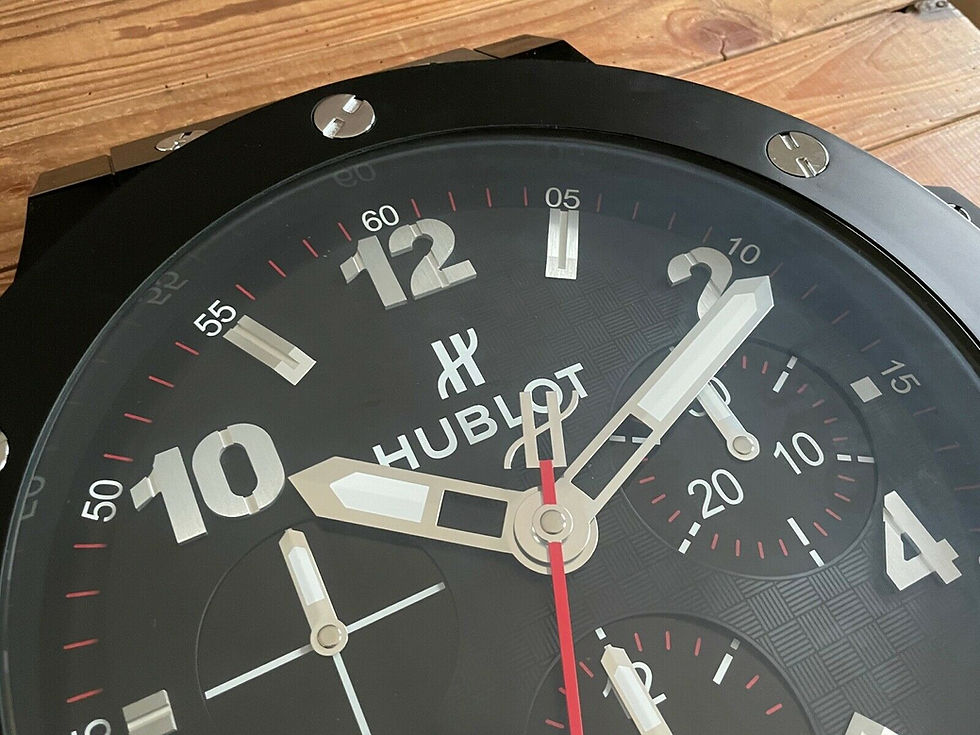
Hublot keeps the Big Bang's most identifiable detail — the six polished, H-shaped titanium-tone bezel screws — front and center on its dealer clocks, produced in both a steel-and-black-ceramic finish and a white-ceramic finish that mirror the brand's two signature wristwatch executions. Official retailer editions run on what Hublot calls a Gen-II High-Torque Silent Sweep module: a quartz movement specifically engineered to run at 0dB, because a boutique full of audibly ticking dealer clocks is not the ambiance any luxury retailer wants. At roughly 49 x 52cm and powered by a single AA battery, it's among the larger formats in the category.
Officine Panerai — Luminor Wall Clock
Panerai's Luminor wall clock reproduces the watch's sandwich dial construction at scale, including the cut-out luminescent numerals — a detail that means the clock genuinely glows in the dark, not just under direct light. It runs on a twin-AA quartz movement built to Panerai's own specification. As noted above, this is the one major house that has sold its wall clocks as a documented retail product rather than reserving them entirely as gifts, which makes a Panerai Luminor clock the lowest-friction way to start a collection in this category with full confidence in its origin.
Spotting a Fake
The fake market here is large and, in some cases, brazen. The most common offenders are oversized homage clocks — typically priced between $50 and $200 — sold on the same listings and storefronts that traffic in "super clone" wristwatches. A frequent giveaway is a sticker covering the movement housing, printed with text like "Rolex Oyster Quartz," pasted over a generic, unbranded quartz module it has nothing to do with. A seller operating out of a Gmail address rather than a verifiable business is itself a useful warning sign.
Four checks separate genuine examples from novelty reproductions.
Weight and material. Authentic dealer clocks use real metal castings consistent with the brand's actual case material, not lightweight injection-molded plastic.
The movement module. Open the case back and look for a named manufacturer — Inducta, Ruegg, ELAG, Kienzle — rather than an anonymous, unbranded quartz unit.
Proportional accuracy. Genuine clocks scale the watch's actual design faithfully; cheap novelty versions often distort proportions to look more conventionally clock-shaped.
Price. Even entry-level genuine examples rarely transact below four figures. A Royal Oak or Big Bang dealer clock offered at $150 is not a bargain — it's a homage.
Building a Display Collection
Wall clocks sit inside a broader family of boutique fixtures that collectors are increasingly treating the same way: display stands, exhibition trays, and presentation cases that brands built to showcase watches inside their own stores, never intended for sale, and now circulating for exactly the reasons that make wall clocks desirable — documented brand origin, genuine scarcity, and an object that was never meant to leave the shop floor. A Patek Philippe wood-and-leather display stand or a Cartier exhibition tray carries the same gift-economy logic as a Royal Oak wall clock; they simply haven't been written about as often.

For a new collector, the discipline is the same as anywhere else in vintage memorabilia: buy from a specialist who can speak specifically to which manufacturer built the piece, ask for documentation rather than taking a listing's word for it, and expect to pay a genuine premium for a verified example. Boutique fixtures were disposable in the brands' eyes. They are not disposable in ours — and the market is increasingly agreeing.

At Episteme Vintage, we source original boutique and dealer-issued watch memorabilia — wall clocks, display stands, and presentation pieces from the world's great Swiss and Italian watchmaking houses — verified before they reach our shelves. Browse the current collection at epistemevintage.com/store.


Comments